Disciplined Progress Framework: 5 Disciplines That Drive Consistent Growth
Introduction
Most of us stumble our way through our personal growth — not because we don’t care, but because we can’t seem to stay consistent. Motivation fades, routines fall apart, and before long we’re back at square one. I’ve been there more times than I want to admit. Honestly, I still am.
But when I look at the times I actually made progress — the times something finally stuck — it was never because of a hack or a burst of inspiration. It was something quieter. A mindset I’ve started calling Disciplined Progress.
It’s a framework for personal growth that focuses less on quick wins and more on the process itself. Because real change doesn’t come from giant leaps; it comes from small, steady steps that stack up over time — until consistency isn’t something you chase, it’s just part of who you are.
What Is Disciplined Progress?
Disciplined Progress is something I stumbled into long before I had a name for it. Every time I’ve made real progress — in my career, my fitness, my creative projects — it hasn’t been because I suddenly figured everything out. It’s been because I found a way to keep showing up. Even when I didn’t feel like it. ESPECIALLY when I didn't feel like it.
After a lot of recent reflection, I started noticing the pattern. The wins that lasted were almost never only about motivation or big moments. They were about small actions and habits that built on each other over time. That’s what this idea is really about — building consistency that quietly changes you.
It’s a framework for personal growth built around five disciplines: Responsibility, Specificity, Habits, Process, and Resilience. Together, they create the structure that keeps you steady when things get messy. When life gets hard. When you get stuck.
Disciplined Progress isn’t about chasing perfection. It's not about ignoring outcomes. It’s about creating the kind of steady, ardent kind of persistence — A rhythm that makes lasting growth possible. One small habit after another. They build on each other.
Want to explore each discipline in depth?
The Disciplined Progress framework is built around five core principles — each with its own mindset and practical ways to apply it in daily life
- Embrace Responsibility — Taking ownership of your choices and actions.
-
Set Specific Goals — Turning broad ambition into clear, actionable direction.
-
Build Small Habits — Creating consistency through simple daily steps.
-
Focus on the Process — Learning to value the work, not just the outcome.
-
Cultivate Resilience — Learning and adapting when things don’t go as planned.
:
Why Discipline Beats Motivation
Motivation is great when you have it. It gives you that spark — the little rush that keeps you going. Feeling almost unstoppable for a day or two. But it doesn’t stick around. Not when you’re tired or stressed. Not when you're doubting yourself. That’s when discipline quietly steps in and does what motivation can’t.
I’ve had moments of “success” powered by motivation alone. After taking nearly a decade off from music, I pulled my guitars out, started producing again, even found a way to make money doing it. I proved I could do it — and then I stopped. The same thing happened again later. Different project, same story. Turns out I love making music when I want to, not when I have to.
My biggest wins came when I leaned on discipline, even before I had a name for it. As a younger man, I co-founded a tech company, moved my family halfway across the country, and worked hard for years to grow it. We eventually sold that business. It shaped my career.
Unfortunately, that all-work lifestyle took a toll on my health. By forty, I was out of shape and out of balance. So I started small. One habit, one decision at a time. I made mistakes, learned, adjusted — and eventually lost more than 100 pounds. I’ve kept it off ever since.
Looking back, I had it backward. Motivation doesn’t create lasting progress — progress creates motivation. Discipline carries you through the dips when the spark is gone. It’s structure with feeling — the steady rhythm that lets you show up again tomorrow, even when today didn’t go as planned.
That’s where Disciplined Progress fits in. It’s not just a mindset; it’s something you can build around your life, not squeeze your life into. Because once discipline becomes part of who you are, you don’t need constant motivation — you’re already in motion.
The 5 Disciplines Of Progress
When I started paying attention to what really worked for me through the ups and downs, I began to notice a pattern. Five things kept showing up. They became the backbone of what I now call Disciplined Progress — a practical framework for steady, measurable growth built on five core principles, or disciplines.
These are the anchors of the Ardent Method — simple, repeatable mindsets that build momentum in every area of life.
1. Embrace Responsibility
Progress begins with accountability. This discipline shifts your focus from being the passenger to being in the driver’s seat. Stop seeing things as happening to you. Seeing yourself as a victim will hold you back.
You have the power — and the responsibility — to act, decide, and adjust. When you take ownership of your actions and choices, you stop waiting for the right time or someone else’s permission. Responsibility creates the foundation for every other form of growth. Because it’s you doing the work. It’s your life. It’s your responsibility to build it.
Embrace that mindset. Remember it. Repeat it.
2. Set Specific Goals
This is a big one for me since I’m such a fan of SMART goals. I think of SMART goals as the tactics — and Disciplined Progress as the strategy. The clarity that comes from being specific is a kind of superpower. You can get so specific, you can’t help but make progress.
Broad ambitions like “get healthy” or “fix my finances” are easy to write down — much harder to actually follow through on. Getting specific means defining what matters and breaking it into measurable, actionable steps. Make the goal as small as it needs to be. That’s how you turn vague, directionless effort into a process with structure and purpose — the kind of progress you can track, improve, and celebrate. And celebrating those small wins is a huge part of the process.
3. Build Small Habits
Real progress is built from small, repeated actions that compound over time. Maybe you’ve heard of concepts like micro-habits or habit stacking. Those ideas are popular for a reason — because they work.
Building small habits replaces raw intensity (motivation) with consistency (discipline). You start stacking tiny wins that add up to lasting change. When you focus on small, doable actions, you start shaping both your results and your identity.
You don’t have to overhaul your life overnight. You just have to keep showing up. Keep stacking the wins. Start small. Make it achievable and repeatable. That’s the process.
4. Focus on the Process
Discipline isn’t just about achievement — it’s about presence. This one’s been a hard lesson for me. “Being present” gets thrown around a lot, but to me, it means actually showing up for what you’re doing — aware, engaged, in the moment.
When you learn to value the process itself, you start to appreciate the small wins we’ve talked about. You celebrate the progress that comes from simply doing the work. And when you understand that setbacks are part of the process, they don’t sting quite so much.
5. Cultivate Resilience
Speaking of setbacks… you’re going to fall off track. I do. Everyone does. Resilience is what helps you get back up without starting over. It’s about staying flexible under pressure, finding the lesson in the challenge, and moving forward with more awareness than before.
Growth doesn’t require perfection; it requires recovery and resilience. Resilience turns struggle into strength and keeps you going long enough for the other four disciplines to work.
Each discipline strengthens the others. Together, they form a framework that turns effort into progress — and progress into confidence. That’s the essence of Disciplined Progress: not just intensity, but ardent intention, repeated daily.
How To Apply Disciplined Progress In Your Life
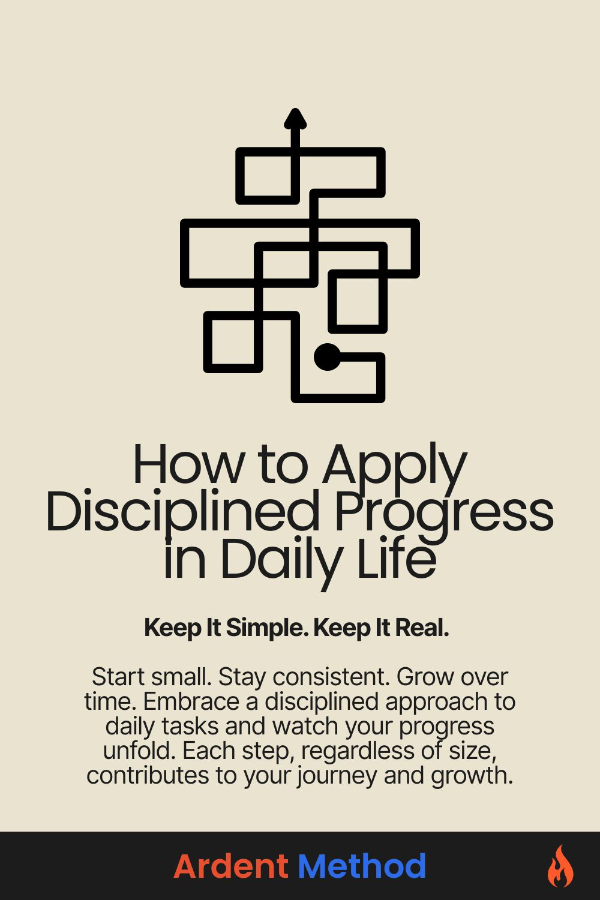
Frameworks, concepts, theories — they all sound great on paper. They can even feel motivating for a while. I’ve read a lot of them. At some point, you realize that motivation fades and theory doesn’t get the work done.
That’s why Disciplined Progress has to live in the real world — the messy, unpredictable one. The world YOU live in. Because we all have different circumstances — different lives Applying Disciplined Progress as a core principle in your personal growth journey means being honest with yourself about where you are. Finding out what you can actually handle right now, and what small step would move you forward today. And again tomorrow. Next week.. Not the perfect version. The realistic one.
Start Small
Start with something small enough that you can’t talk yourself out of it. For example:
- Five minutes of walking or other exercise.
- Drinking more water.
- 10 minutes journalling about your day.
- Reaching out to someone you’ve been meaning to reconnect with.
- Taking a few moments alone to reflect or get your mind right before work.
These are just examples. An easy way to get started. You have to identify a small lever to pull that will make a difference in YOUR day. In YOUR week. These tiny habits are how you stay consistent with your goals — because they’re achievable, repeatable, and real.
Personalize It
That’s exactly what the Ardent Method quiz and free personal growth plan are built to do — help you identify where to focus, and turn this framework for personal growth into something you can actually use. Small, specific steps that fit your personality, your goals and situation.
Because big change never starts big. It starts with one honest action that leads to another, and another. That’s how you make steady progress — and that’s how you grow.
Keep it simple. Keep it real. Keep showing up.
If you’re curious where you stand — or what your next small step could be — take the Ardent Method quiz. It’s a quick way to see how the five disciplines show up in your life right now.
Ready to go deeper? The quiz also gives you a free personal growth plan built around your goals, habits, and focus areas — a practical way to turn Disciplined Progress into something real.
Frequently Asked Questions
- What is the main idea behind Disciplined Progress?
- It’s about building steady, measurable growth through small, consistent actions — not waiting on motivation to strike. It’s a framework for personal growth built on five simple disciplines: Responsibility, Specificity, Habits, Process, and Resilience.
- How is Disciplined Progress different from other goal-setting methods?
- Most systems focus on motivation or willpower. Disciplined Progress focuses on structure, clarity, and self-awareness — things you can actually control. It’s not about doing more; it’s about doing what matters, consistently, and adapting as you grow.
- Do I have to follow all five disciplines at once?
- Not at all. Start with one that resonates — maybe Responsibility if you’re stuck waiting for the “right time,” or Habits if you’re struggling with follow-through. They build on each other naturally once you start applying them.
- How do I know which discipline to focus on first?
- That’s where the Ardent Method quiz comes in. It helps you see which areas might be holding you back right now and gives you a personalized growth plan to build momentum. It’s free, quick, and grounded in these same five principles.
- What if I’ve tried systems before and they didn’t work?
- You’re not alone. I've done that. Most people fail because they try to change everything at once. Disciplined Progress is about starting small — actions that fit your life, not force it. Once you make one small, consistent change, the rest gets easier.
- How long does it take to see results?
- That depends on what you’re working toward, but most people start noticing shifts in a few weeks. Not just in outcomes — in how they feel about progress itself. Because when you focus on the process, results stop being temporary.